
The 2024 Nobel Prizes in Physics and Chemistry were awarded for research in the field of artificial intelligence (AI) and its applications. AI has led to paradigm shifts in many areas, such as the Internet of Things, biomedicine, robotics, microrobots implanted in the body, virtual reality, and second-generation quantum technology such as quantum sensing, quantum imaging, quantum communication and quantum computing, which utilizes superposition states and quantum entanglement, allowing factorizations to be solved exponentially faster.
AI has become a driving force in society, which has greatly benefited from its rapid development. The advance of AI will cause upheavals more profound than the invention of the printing press or the three previous industrial revolutions. AI is already part of everyday life, as seen in recommendation systems for online product purchases, autocorrect and simplified text recognition for internet. Since November 2022, when the chatbot ChatGPT was made available to the general public, AI has represented a paradigm shift in document creation. AI could be particularly beneficial in medicine, enabling the rapid analysis of vast amounts of data for prevention, diagnostics, and therapy.
Generative models—also called synthesis models, such as ChatGPT—have achieved remarkable improvements beyond simple classification. However, inference in large, pre-trained generative AI models requires a significant investment of energy and time. Therefore, the development of new intelligent chip architectures for energy-efficient neural networks is becoming a challenge in unlocking the potential of AI.
Artificial neural networks (ANN) are mathematical models that mimic the processing power of the biological brain. However, the hardware used is predominantly based on classic von Neumann architectures, which struggle to keep pace with the ever-increasing demand for processing speed and consume large amounts of energy. This applies a limit to both CPUs and GPUs. The main limitation stems from the separation of processing and memory inherent in von Neumann architectures, which consumes a lot of energy and limits computing power when reading and writing data. There is also an electronic bandwidth bottleneck, with the clock speed of conventional electronic digital processors limited to a few GHz. The development of new technologies that have the potential to overcome these limitations in the separation of memory and processor is of great importance.
The unique advantages of light, such as its ultrawide bandwidths of up to several tens of THz, the low propagation loss of optical fibers, and the inherent nature of its parallel architecture, make optical neuromorphic computer hardware a promising solution for addressing the challenges faced by its electronic counterparts. Ultimately, hybrid optoelectronic computer hardware that leverages the wide bandwidth of optical components can deliver significant performance improvements for many applications.
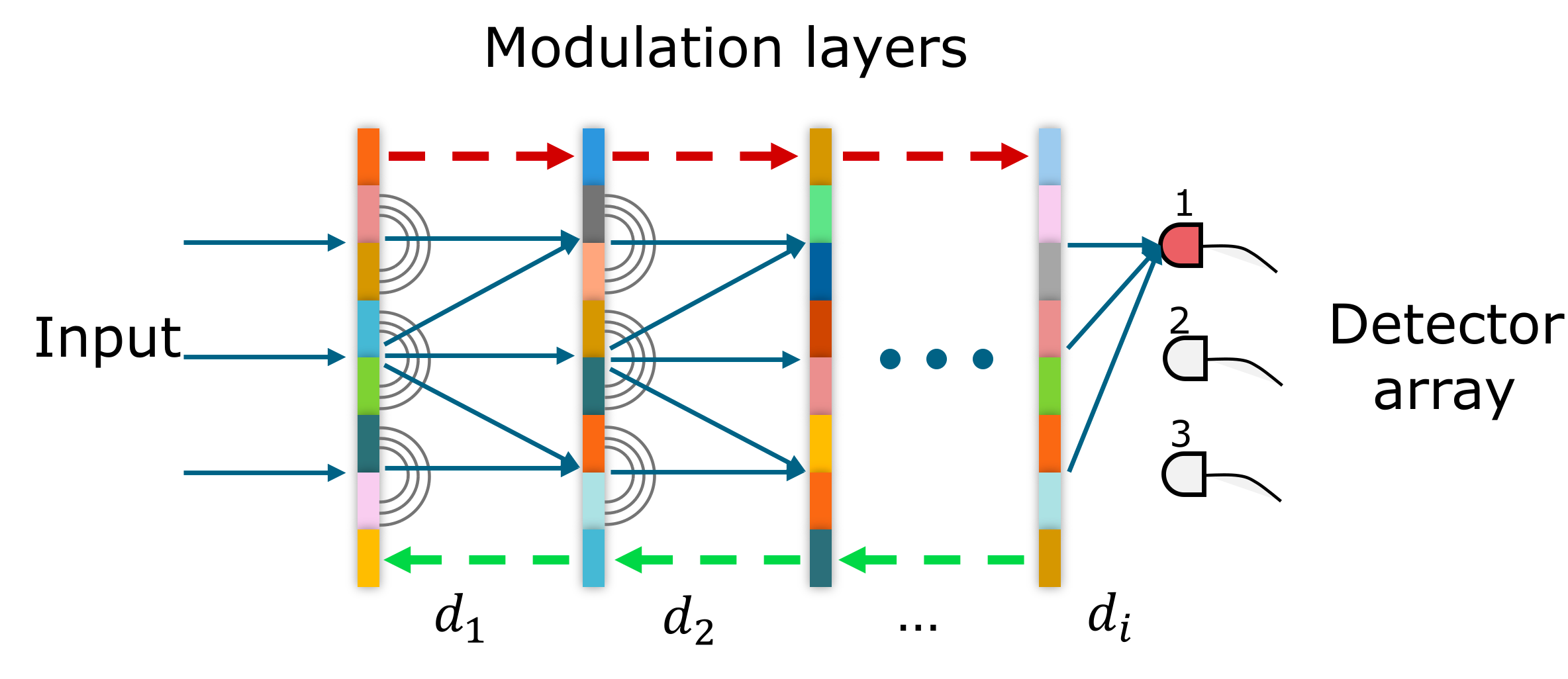
Optical neural networks use light as an information carrier and can simultaneously perform the desired computational functions by propagating through specially designed dielectric structures or free space, thus eliminating the separation of processing and storage functions. This passive process effectively improves energy efficiency and reduces latency.
Professor Jürgen Czarske has received a Reinhart Koselleck Project Prize Grant from the German Research Foundation (DFG) for „Physics-Based Deep Learning Systems for Secure Information Transmission via Multimode Fibers (MMF)“ (Phys-Deep-Fiber). The ambitious goal of this project, for which Professor Czarske has once again received DFG project prize funding, is the novel neuromorphic concept for multiplexing of information in scattering media towards advancements of the internet of things, advanced information technology, optical computing, and endoscopic imaging for diagnostics and therapies in biomedicine. The Koselleck project research prize offers professors with outstanding scientific achievements and significant research potential the opportunity to conduct highly innovative projects with maximum freedom over a period of five years. The grant of €1.5 million awarded to Professor Czarske will enable fundamental research in the field of neuromorphic computing for paradigm shifts in information transmission towards novel internet.
Fiber optic communication technology forms the backbone of the internet. Advances in optical technology are crucial – not only for the continued exponential growth of data rates, but especially for data security and the energy-saving paradigm shift in information technology. This shift is made possible by the use of multimode fibers instead of single-mode fibers. However, scattering poses a challenge for information transmission in multimode fibers. The Koselleck project addresses this challenge with novel, XAI-based measurement systems that combine data-driven algorithms with physical models. Optical neural networks are trained using artificial intelligence but do not require energy-intensive GPUs. Optical neural networks represent a paradigm shift not only in terms of energy consumption and sustainability, but also in the real-time measurement of light scattering. This enables quantum-safe encryption – unlike classical cryptography – by utilizing physical laws through quantum key distribution (QKD). The project’s vision is to fundamentally improve information transmission for advancements on the internet through physics-based deep learning.
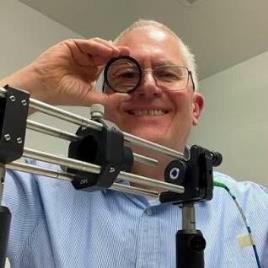
Professor Czarske heads the BIOLAS Competence Center, the Reinhard-Koselleck-Group, and the IEE Institute at the Faculty of Electrical and Computer Engineering, is a co-opted professor of physics, and a visiting professor in Arizona, at SIOM and at USST. He recently received the Dennis Gabor Award from SPIE (International Society for Optics and Photonics, USA) in San Diego for his groundbreaking work in digital holography and diffractive optics. The Reinhart Koselleck Project Prize offers greater freedom for particularly innovative and high-risk research. Prof Czarske´s first Koselleck Project was approved in 2014 and enabled fundamental research successes on adaptive optics for advanced process techniques and green energy engineering. The second Koselleck project prize, approved in 2025 and launched on January 1, 2026, aims to bring about paradigm shifts in green optical computing for novel information technique and internet of things.
Partners: UCL London, USST, SIOM, Wyant College Arizona, TU Munich, TU Braunschweig, Creol Florida, Fraunhofer Gesellschaft, Deutsche Telecom Chair, Toptica, qutools GmbH, etc.
If you are interested in collaborating with the Reinhart-Koselleck Group, please contact the following staff members regarding their research areas:
- Qian Zhang, Postdoc: qian.zhang@tu-dresden.de
- Experiment and Simulation / Novel concepts using physics-informed ANN, optical diffractive neural networks and optical computing towards important Applications in classical and quantum communication using MMF. Further topics: Orbital Angular Momentum, OAM, for information transmission through scattering media; entangled photons for quantum information transmission; High-speed transmission of data through MMF
- Bowen Yang, PhD: bowen.yang@tu-dresden.de
- Experiment / 12 km fiber-based information transmission technique. Phase Conjugation towards Space Division Multiplexing (SDM) and Physical Layer Security exploiting the transmission matrix for novel communication technique, also multimode fiber endoscopy and distributed fiber sensing
- Jie Zhang, PhD: jie.zhang4@mailbox.tu-dresden.de
- Experiment / Novel optical diffractive neural networks, ODNN, and Multiplane Light Conversion, MPLC, unique advantages transfered to important applications such SDM, incl. novel MUX/DEMUX on MMF
- Jiali Sun, PhD: jiali.sun@tu-dresden.de
- Simulation / Physics-informed deep learning for GPU-based Mode Decomposition of Multimode Fibers, MMF, e.g. advancements in information transmission through scattering media
- Yuedi Zhang: yuedi.zhang@tu-dresden.de
- Engineering and Simulation / ODNN and realizing novel techniques using LCoS-SLM, TI MEMS, DSP, GPU, NPU, etc.
References:
Unlocking mode programming with multi-plane light conversion using computer-generated hologram optimisation, S Rothe, FA Barbosa, JW Czarske, FM Ferreira, Journal of Physics: Photonics 7 (1), 015002, 2024
Multimode optical interconnects on silicon interposer enable confidential hardware-to-hardware communication, Q Zhang, S Charania, S Rothe, N. Koukourakis, N Neumann, …, JW Czarske, Sensors 23 (13), 6076, 2023
Securing data in multimode fibers by exploiting mode-dependent light propagation effects, S Rothe, KL Besser, D Krause, R. Kuschmierz, N. Koukourakis, …, JW Czarske, Research 6, 0065, 2023
Intelligent self calibration tool for adaptive few-mode fiber multiplexers using multiplane light conversion, D Pohle, FA Barbosa, FM Ferreira, J Czarske, S Rothe, Journal of the European Optical Society-Rapid Publications 19, 2023
Secret Key Generation Over Multi-Mode Fiber: Channel Measurements, Key Rate Analysis, and System Implementation, PH Lin, P Nowitzki, EA Jorswieck, D Pohle, J Czarske, IEEE Open Journal of the Communications Society, 2025
Q. Zhang, Y. Zhang, and J. W. Czarske, „FPGA-accelerated mode decomposition for multimode fiber-based communication“, Light: Advanced Manufacturing, 2025
Fei Wang, Juergen W. Czarske, and Guohai Situ, Deep learning for computational imaging: from data-driven to physics-enhanced approaches, Advanced Photonics, 2025
J Czarske , Q Zhang, „Receiving Device and Method for Determining Transmission Characteristics of an Optical Waveguide“, Patent A 5800, 2025
D. Pohle, D. Fröming, J.W. Czarske, E. Jorswieck, “In-network Optical Reservoir Computing for Spatial Channel Recovery of Multimode Fibers”, IEEE-SUM 2025, IEEE Photonics Society, July 2025, Berlin, Germany
Q. Zhang, Y. Miao, J. Sun, Y. Sui, S. Rothe, and J.W. Czarske, “Digital design of mode decomposition systems for multimode fibers using physics-informed neural network,” SPIE Optics and Photonics, Emerging Topics in Artificial Intelligence (ETAI), San Diego, California, US, 07 August 2025
Q. Zhang, Y. Zhang, J.W. Czarske, Digital in Design: FPGA-based Implementation of Deep Learning for Demultiplexing and Mode Decomposition of Structured Light, SPIE Digital Optical Technologies, 13573-3, Munich, 23 June 2025
J. Sun, Q. Zhang, J.W. Czarske, Physics-informed neural network with pretraining for mode decom-position of 1-km long multimode fiber, 13573-15, SPIE Digital Optical Technol-ogies, Munich, June 2025
Y. G. Zena, M. Pal, M. Langer, D. Sai, A. Rahimi, R. Bassoli, A. A. Bayelgn, J. W. Czarske, and C. Hopfmann, “Enhanced emission of GaAs quantum dots in bend nanomembranes,” Proc. SPIE 13618, Quantum Communications and Quantum Imaging XXIII, 136180J (18 September 2025); https://doi.org/10.1117/12.3065657
J. W. Czarske, Q. Zhang, J. Sun, M. Yu, Digital holography and physics-informed neural networks for mode decomposition of multimode fibers towards classical and quantum com-munication, invited talk, at OPTO-SPIE Photonics West, 29 January 2025 • 3:00 PM – 3:30 PM PST | Moscone Center, Room 2006 (Level 2 West)
J.W. Czarske, T. Wang, J. Dremel, R. Kuschmierz, S Richter, W. Polanski, I. Eyüpoglu, O. Uckermann, Brain cancer diagnosis using lensbased multicore-fiber endoscopy with a learn-ing-based digital twin, invited by F. Willomitzer, University of Arizona, 3. Feb. 2025
J.Sun, X. Yang, D. Krause and J.W. Czarske, AI-driven fiber-optic cell ro-tation for tomographic imaging, invited talk at Optica Biophotonics, 20.-24.04.2025, Coro-nado, USA
J.W. Czarske, J. Dremel, L. Buettner, Anniversary 20 years of MST and celebration of international year of quantum science and technology (official event of Unesco), Dresden, 4 April 2025
J.W. Czarske, J. Zhang, N. Koukourakis, J. Sun, Quantitative Phase Imaging by Endomi-croscopy exploiting Deep Holography towards Microelectronics and Biomedicine, World In-terferometer Day to celebrate the anniversary of A Michelson (invited by Prof Manske and Prof Osten), Ilmenau, 9 April 2025
J. W. Czarske, Q. Zhang, J. Sun, Miao Yu, L. Buettner, N. Koukourakis, Intelligent Photon-ics for Information Processing in Biomedical Diagnostics and Fiber Communication, SIOM seminar, Shanghai, June 4, 2025
J.W. Czarske, T. Glosemeyer, Q. Zhang, R. Kuschmierz, Theory-Trained Neural Networks for advancements of waveguide-based applications towards augmented reality (AR), fiber endomicroscopy and quantum fiber communication, Light Conference of Nature, Changchungm 9-13 June 2025
J.W. Czarske, T. Glosemeyer, R. Kuschmierz, Advancements for waveguide-based augmented reality (AR) and diffuser endomicroscopy by Theory-Trained Neural Networks (Invited Paper), 13573-19, SPIE Digital Optical Technologies, Munich, 23-26 June 2025
J.W. Czarske, T. Glosemeyer, R. Kuschmierz, Q Zhang, J. Sun, B. Yang, Theory-Trained Neural Networks for advancements of computational imaging in biomedicine and fiber communication, Keynote talk, Xi´an, Optics Frontier—The 16th International Confer-ence on Information Optics and Photonics (CIOP 2025), Sessions Optical Imaging, Display and Storage / Photonics for AI +AI for Photonics, 10-14 August, 2025
J.W. Czarske, R. Wendland, J. Dremel, T. Wang, R. Kuschmierz, N. Koukourakis, J. Sun, Computational lensless 3D imaging for advancing biomedicine, SIBET, Suzhou, August 18, 2025
J.W. Czarske, J. Dremel, T. Wang, R. Kuschmierz, N. Koukourakis, J. Sun, Computational 3D single-shot imaging with keyhole access for paradigm shifts in biomedicine and engineer-ing, Nanjing, invited by Prof Chao Zuo, August 19, 2025
J.W. Czarske, L. Buettner, F. Schmieder, R. Wendland, N. Koukourakis, J. Sun, Computa-tional 3D single-shot imaging with keyhole access for paradigm shifts in biomedicine, SIOM seminar, Shanghai, invited by Fei Wang, August 20, 2025
J.W. Czarske, Modern laser metrology for advancements in manufacturing, flow engineer-ing and biomedicine, Shanghai Institute of Laser Material Processing, invited by the general manager Prof Guohai Situ, August 21, 2025
J. W. Czarske, Q. Zhang, J. Sun, Y. Zhang, B. Yang, Y. Sui, L. Büttner, S. Krause, Theory-trained deep holography for mode decomposition towards multimode fiber-based information transmission, SPIE/COS Photonics Asia, Beijing, October 12, 2025
J. Sun, Q. Zhang, J.W. Czarske, Deep learning-based mode decomposition in multi-mode fibers: a paradigm shift from data-driven to physics-driven, 2025 Frontiers in Optics + Laser Science meeting, 26-30 October, Denver, Colorado, USA
J.W. Czarske, Neuromorphic information processing exploiting physics-informed deep learning, quantum technology and optical diffractive neural network, SPIE-CLP Conference on Advanced Photonics 2025, AI Photonics Session, November 15, 2025, Hong Kong
J.W. Czarske, Advancing computational imaging using physics-informed deep learning towards biomedicine and metaverse, SPIE-CLP Conference on Advanced Photonics 2025, AI Photonics Session, November 16, 2025, Hong Kong
Q. Zhang, J.W. Czarske, Seeing through the distortions of multimode fiber towards high fidelity information Transmission, SPIE-CLP Conference on Advanced Photonics 2025, AI Photonics Session, November 16, 2025, Hong Kong
Zuhra Amiri, Riccardo Bassoli, Holger Boche, Sujay Ashok Charania, Juergen W. Czarske, Siddharth Das, Christian Deppe, Sourav Dev, Frank H. P. Fitzek, Muhammad Idham Habibie, Jonas Hawellek, Menglong He, Kambiz Jamshidi, Davide Li Calsi, Shivam Maheshwari, Swa-raj S. Nande, Kumar Nilesh, Janis Nötzel, Dirk Plettemeier, Abdou Shetewy, Chandan Upadhyay, and Q. Zhang, “Quan-tum Technologies for 6G Networks”, Chapter 18, 6G-life Unveiling the Future of Digital Sovereignty, Sustainability, and Trustworthiness, Edited by Frank H. P. Fitzek, Holger Boche, Wolfgang Kellerer, Patrick Seeling, Springer, 2025
Z. Amiri, R. Bassoli, H. Boche, S. A. Charania, J. W. Czarske, S. Das, C. Deppe, D. L. Calsi, S. Ma-heshwari, S.S. Nande, K. Nilesh, J. Nötzel, and Q. Zhang, “Quantum Technology Applications for 6G Networks”, Chapter 19, 6G-life Unveiling the Future of Digital Sovereignty, Sustainability, and Trustworthiness, Edited by Frank H. P. Fitzek, Holger Boche, Wolfgang Kellerer, Patrick Seeling, Springer, 2025
Saquip Amjad, Bensu Baran-Akin, Paolo Carniello, Juergen W. Czarske, Norbert Hanik, Alex Jäger, Carmen Mas Machuca, Dennis Pohle, Stefan Rothe, and Maria Samonaki, “The Role of Optical Communication Networks as Service Enabler, for Quantum Communications, and Physical Layer Security”, Chapter 9, 6G-life Unveiling the Future of Digital Sovereignty, Sus-tainability, and Trust-worthiness, Edited by Frank H. P. Fitzek, Holger Boche, Wolfgang Kel-lerer, Patrick Seeling, Spring-er, 2025
Moritz Wiese, Michael Pehl, Dennis Pohle, Luis Torres-Figueroa, Johannes Voichtleitner, Ullrich J. Mönich, Daniel Seifert, Holger Boche, Juergen W. Czarske, Rafael F. Schaefer, and Georg Sigl, “Phys-ical Layer Security for 6G”, chapter 20, 6G-life Unveiling the Future of Digital Sovereignty, Sustaina-bility, and Trustworthiness, Edited by Frank H. P. Fitzek, Holger Boche, Wolfgang Kellerer, Patrick Seeling, Springer, 2025