
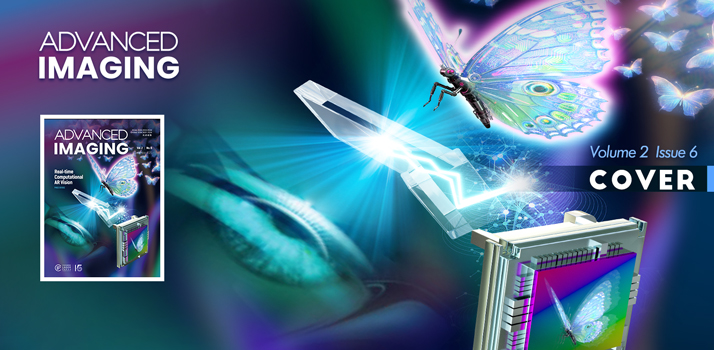
The evolution of computer technology—from mainframes to home PCs and smartphones—has also reached wearable devices like smart glasses. The Internet of Things (IoT) necessitates a paradigm shift for augmented reality (AR), which integrates digital information into the real world in real time, thus augmenting our perception of our surroundings rather than replacing them, as in virtual reality (VR). AR presents digital content onto wearable devices such as smart glasses. The seamless integration of cameras is a fundamental requirement for further development and presents a significant challenge.
The cover paper, “Real-time physics-informed neural network image reconstruction for a see-through camera via an AR lightguide,” presents a novel physics-based approach using neural networks that enables real-time imaging without the need for complex cameras. The use of AI democratizes AR by eliminating the need for complex hardware with lens systems and enabling the use of cost-effective, globally available AI software for image acquisition. This paradigm shift is relevant for Advanced Internet and Robotics (Cluster 6G-life) and digital medicine (EKFZ Center), as well as for innovative computational imaging (BIOLAS Competence Center).
https://m.researching.cn/ai/volumes/2/issues/6?alichlgref=https%3A%2F%2Fwww.bing.com%2F
https://m.researching.cn/articles/OJ9ffa9bd7953a5c32
https://m.researching.cn/EN/SetArticlePdfDownload?id=OJ9ffa9bd7953a5c32&description=Article