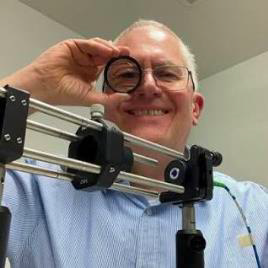
Ultrasound Research
- Ultrasound imaging for extreme environments and energy systems
- Non‑destructive testing using advanced wave physics
- Portable 3D brain imaging beyond MRI limitations
Contact
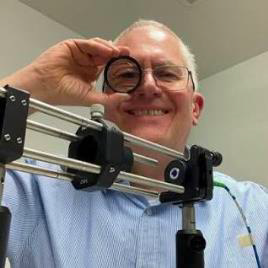

Cherif Othmani & Jürgen Czarske
Holographic Stimulation Platform for Optogenics
- Uses structured light, adaptive optics, and computational imaging for biomedical, environmental, and information technology applications.
- Develops advanced systems for optogenetics, 3D microscopy, and imaging through obstacles or fog.
- Aims to improve biomedical research, energy efficiency, and innovative photonics technologies.
Contact

Lars Büttner & Jürgen Czarske
Imaging, Energy & Ultrasound Innovation Lab
- AI and compressed sensing for super‑resolution imaging in real‑world systems
- Ultrasound diagnostics boosting hydrogen energy efficiency and green technologies
- Advanced sensing methods applied to biomedicine, therapy, and diagnostics
Contact
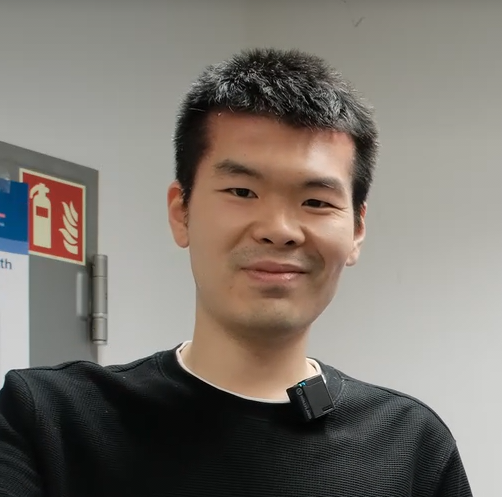
Zehua Dou & Jürgen Czarske
Pushing the Limits of Fiber Endoscopy for Medicine
- Ultra-thin multi-core fibers enable high-resolution imaging through microscopic access points
- AI and holography unlock lensless, multi-color imaging inside flexible fibers
- Minimally invasive medical endoscopy for neuroscience, dentistry, and cochlear implants
Contact
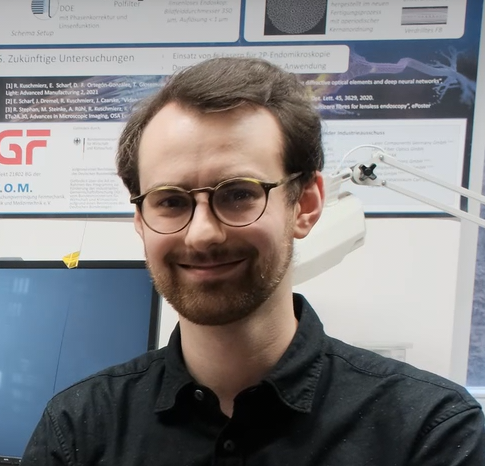
Jakob Dremel & Jürgen Czarske
Adaptive Optical Measurement Techniques for Flow and Particle Analysis in Energy Systems
- Focus on efficient energy processes, especially hydrogen conversion in fuel cells.
- Uses adaptive optics to study flow inside droplets and bubbles.
- Helps improve environmental and industrial technologies.
Contact

Clemens Bilsing & Jürgen Czarske
Intelligent Photonics & Optical Computing
- Focus on optical computing & intelligent photonics to reduce energy use and enable fast, real-time processing.
- Combines AI and Photonics to build brain-inspired (neuromorphic) optical computers
- Enables efficient data processing & IoT applications, with major breakthroughs in optical signal routing and multiplexing
Contact

Jie Zhang & Jürgen Czarske
Deep Tissue Imaging Using Femtosecond Lasers and Micro-Robots with Nonlinear Optics
- The project focuses on imaging deep inside biological tissue, which is difficult due to light scattering and distortions.
- Researchers use micro-robots with nonlinear optical materials (second harmonic crystals) that act as a guide star, helping distinguish useful signals from scattered light.
- This technology enables advanced biomedical applications, such as imaging, laser-based treatments (burning infections), and micro-scale actuation inside the body.
Contact

John Böhm & Jürgen Czarske
AI-based Intelligent Photonics for Fiber Communication
- Uses AI + optics to improve fiber communication.
- Develops tiny devices to control and separate light signals.
- Aims for faster, efficient, and future (quantum) communication systems
Contact

Qian Zhang & Jürgen Czarske
Quantum Imaging with Undetected Light
- Uses quantum entanglement to create images without directly detecting the light interacting with the sample.
- Enables imaging with infrared light using normal cameras, improving efficiency.
- Aims to achieve 3D imaging for biomedical applications using advanced optics.
Contact

Stefan Krause & Jürgen Czarske
Femtosecond Laser Microscopy with Adaptive Lenses for Biomedical Imaging
- Uses femtosecond lasers and adaptive lenses for advanced nonlinear microscopy.
- Enables high-resolution 3D imaging with aberration and scattering correction.
- Aims to improve deep, high-quality imaging of biological samples.
Contact

Svea Steuer & Jürgen Czarske
AI-Based Lensless Endoscopy with Intelligent Photonics
- Combines physics + deep learning to create a lensless endoscope for minimally invasive imaging.
- Uses a diffuser and AI reconstruction to achieve high-resolution 3D imaging.
- Enables tiny, advanced imaging systems for biomedicine and future technologies.
Contact

Tom Glosemeyer & Jürgen Czarske
Light-Driven Rotation of Organoids for 3D Biomedical Imaging
- Uses light-based optical spanners to rotate organoids and biological cells for imaging from all angles.
- Enables label-free 3D refractive index imaging to study disease development in real time.
- Aims to reduce animal testing and improve understanding of biological structure and function in biomedical research.
Contact

David Krause & Jürgen Czarske
The high-speed holographic interferometry
- Combines digital holography and AI to monitor laser welding processes in real time.
- Enables accurate measurement of the keyhole structure, which directly affects weld quality.
- Aims to create smart sensors for industrial welding robots, improving efficiency, quality, and reducing waste.
Contact

Alexander Thees & Jürgen Czarske
Deep Learning–Based Mode Decomposition in Multimode Optical Fibers
- Uses deep neural networks + physics models to extract information from complex speckle patterns in multimode fibers.
- Achieves fast and accurate reconstruction of light modes (up to many modes) with high correlation results.
- Enables applications like high-capacity fiber communication, secure transmission, and optical signal analysis.
Contact

Jiali Sun & Jürgen Czarske
AI-Enhanced Optical Biopsy for Fast Cancer Diagnostics
- Uses optical fiber endoscopy, AI, and digital twins for high-resolution cancer imaging.
- Enhances imaging beyond traditional diffraction limits using deep learning techniques.
- Aims to speed up cancer diagnosis from one week to about one hour for medical applications.
Contact

Tijue Wang & Jürgen Czarske
Optogenetics and Real-Time Control of Human Heart Cell Dynamics
- Combines holographic light stimulation and real-time imaging to study human heart cell contractions.
- Uses a closed-loop system to control and analyze abnormal cardiac wave patterns.
- Aims to improve understanding of heart diseases and support future pacemaker and biomedical research without animal experiments.
Contact

Robert Wendland & Jürgen Czarske
Secure Communication Through Multimode Fiber Networks
- The work explores how light behaves inside a very long (12 km) multimode fiber to understand its transmission properties.
- Because the system is naturally unstable, it becomes difficult to measure and control signals in a traditional way.
- Instead of treating this as a problem, the group uses it to develop secure communication methods, including shared key generation directly from the fiber.
Contact

Bowen Yang & Jürgen Czarske
Smart Microscopy and Micro-Robots for Biomedical Applications
- Works on smart microscopy using wavefront shaping and structured light for advanced imaging.
- Develops micro-robots for diagnosis, drug delivery, and cancer treatment in deep tissue.
- Strong focus on computational optics and international research collaborations.
Contact

Nektarios Koukourakis & Jürgen Czarske
Holographic Optogenetics for Biomedical Research
- Uses holographic optogenetic stimulation with advanced laser systems to study neurons and heart cells.
- Enables precise stimulation and control of biological tissues, including organoids and stem-cell-derived cultures.
- Aims to better understand neurological and heart diseases while supporting future therapeutic applications.